

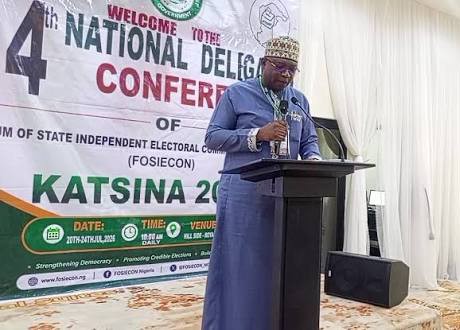


The Forum of State Independent Electoral Commissions of Nigeria (FOSIECON) has called for greater financial and institutional independence for State Independent Electoral Commissions (SIECs) as part of efforts to strengthen grassroots democracy and restore public confidence in local government elections.
The call formed part of the resolutions reached at the 14th National Delegates Conference of FOSIECON, held in Katsina State from July 20 to 24, 2026, under the theme, “Understanding Voter Apathy in Nigeria’s Elections: Reality or Misconception.”
The conference brought together electoral officials, legal experts, academics, civil society organisations, development partners, security agencies, media practitioners, and other stakeholders to examine challenges affecting local government elections and identify practical solutions.
Participants observed that while SIECs remain indispensable to Nigeria’s democratic process at the grassroots, their effectiveness continues to be hampered by inadequate funding and limited institutional independence.
They noted that poor and irregular funding has weakened the capacity of many commissions and undermined the credibility of local government elections.
The conference also identified insecurity, misinformation, inadequate voter education, political distrust, economic hardship, and the widespread belief that votes do not count as major factors responsible for voter apathy.
However, delegates agreed that Nigerians are willing to participate actively in elections when they are convinced that the process is free, fair, transparent, and credible.
Delegates stressed that rebuilding public confidence in elections requires stronger collaboration among SIECs, the Independent National Electoral Commission (INEC), political parties, security agencies, civil society organisations, traditional institutions, and the media.
The conference further expressed concern over the low representation of women in local government politics, attributing the situation to cultural, economic, and political barriers. It emphasized the need for greater inclusion of women, youths, and persons with disabilities in governance to promote a more representative and effective democratic system.
Among its major resolutions, FOSIECON urged state governments to grant financial autonomy to SIECs by allocating one percent of monthly local government allocations to fund their operations.
It also called on states to review their electoral laws to align with constitutional provisions while enhancing transparency, accountability, and the deployment of technology in electoral processes.
The conference recommended that SIECs deepen partnerships with INEC, security agencies, civil society groups, and the media to ensure peaceful, transparent, and credible elections.
It also advocated sustained voter education, civic engagement, and wider use of technology to improve voter participation across the country.
In addition, participants urged governments and political parties to remove obstacles limiting women’s participation in elections and adopt policies that encourage more women to contest elective positions.
Stakeholders were also called upon to intensify efforts to combat electoral violence, misinformation, and discrimination while promoting inclusive democratic practices.
At the end of the conference, FOSIECON reaffirmed its commitment to building strong, independent, innovative, and professionally competent State Independent Electoral Commissions capable of conducting free, fair, transparent, and inclusive local government elections.
The forum maintained that sustainable funding, institutional reforms, continuous voter education, democratic innovation, and broader inclusion of underrepresented groups remain critical to restoring public trust in elections and strengthening democracy at the grassroots across Nigeria.