

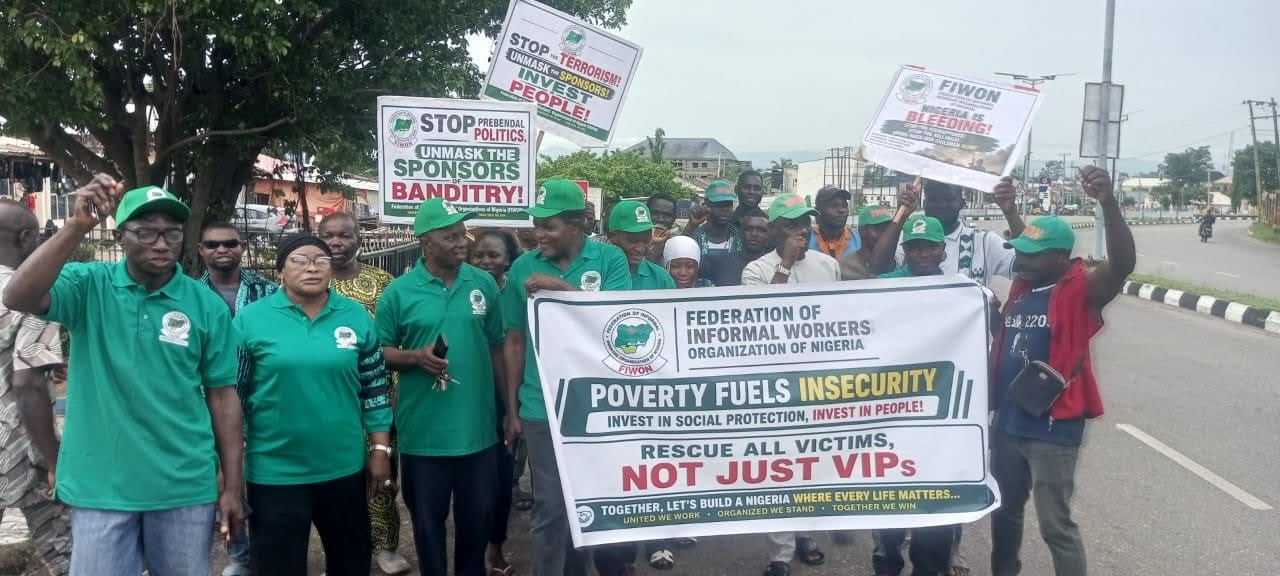

The Federation of Informal Workers Organizations of Nigeria (FIWON) has called on the Federal and State Governments to prioritize social protection as a key strategy for addressing the growing insecurity, banditry, and kidnapping across the country.
In a Democracy Day statement signed by its General Secretary, Comrade Gbenga Komolafe, the organization argued that the worsening security situation is closely tied to widespread poverty, unemployment, and the lack of social safety nets for millions of Nigerians, particularly those working in the informal sector.
FIWON noted that while June 12 is celebrated as a symbol of Nigeria’s democratic journey, many citizens have yet to experience the benefits of democracy due to economic hardship, lack of access to basic services, and growing insecurity.
According to the organization, democracy has remained largely ineffective for the over 93 percent of Nigerians employed in the informal economy, many of whom struggle daily with inadequate income, rising living costs, limited healthcare access, and the absence of pension protection.
The group expressed particular concern over the recent abduction of school pupils and teachers in Oyo State, describing the incident as a stark reminder of the country’s deepening social and security crisis.
FIWON stated that the attack highlighted the failure of government institutions to guarantee the safety of citizens and protect educational facilities, adding that the kidnapping was not an isolated event but a reflection of broader social exclusion and economic desperation.
The organization argued that insecurity should not be viewed solely as a military challenge but also as a consequence of poor social welfare policies. It maintained that unemployed and vulnerable youths are more susceptible to recruitment by criminal groups due to the lack of viable economic opportunities.
Citing available statistics, FIWON lamented that only about 152,000 of Nigeria’s estimated 77 million informal workers are enrolled in the micro-pension scheme, while health insurance coverage remains below 10 percent of the population.
The group further noted that the informal economy contributes significantly to Nigeria’s Gross Domestic Product (GDP) and provides employment for the majority of the workforce, yet workers in the sector continue to face low earnings, unsafe working conditions, and limited access to credit, training, and social protection.
FIWON also drew attention to the humanitarian impact of insecurity across several states, including Kwara, Zamfara, Sokoto, Katsina, Kaduna, Kano, Kebbi, and Jigawa, where communities have reportedly been displaced by persistent violence and attacks.
As part of its Democracy Day demands, the organization called for government co-contributions to micro-pension schemes for informal workers, subsidized health insurance premiums, free healthcare for vulnerable groups, and the extension of workplace compensation laws to cover informal sector workers.
Other demands include large-scale investment in job creation, skills acquisition programmes, access to affordable credit, and stronger support for small businesses and informal enterprises.
FIWON also condemned forced evictions in parts of the country, particularly Lagos State, claiming that more than one million people have been affected over the past two decades. It urged governments to invest in social housing and provide alternative accommodation where evictions become unavoidable.
The organization further called for improved security around schools and vulnerable communities to ensure children can pursue education without fear of abduction or violence.
Addressing President Bola Ahmed Tinubu, FIWON urged the Federal Government to adopt a comprehensive approach that combines military action against criminal groups with policies aimed at reducing poverty and expanding social protection coverage.
According to the group, lasting security can only be achieved by addressing the socio-economic conditions that make criminal recruitment attractive to many young people.
FIWON concluded by urging informal workers across the country to continue advocating for recognition, dignity, and protection, insisting that Nigeria cannot build a secure and prosperous society while millions remain trapped in poverty and social exclusion.